Showing posts with label Phnom Penh. Show all posts
Of course no trip to Cambodia would be complete without visiting Siem Reap and the nearbytemples of Angkor, but if travelers have the time they really shouldn’t overlook the capital city Phnom Penh, once known as the “Pearl of Asia”. And even though it has risen from the darkened ashes of war that took place during the 70’s and 80’s, it still retains much of the look and feel of Asia from several decades ago. If you are lucky enough to get to visit this adventurous city here are ten things, in no particular order, that you should definitely consider exploring while you are there.
1. Royal Palace and the Silver Pagoda
Royal Palace
Very similar in style to the Royal Palace in Bangkok, this official residence of King Sihamoni has classic Khmer roofs and elaborate gilding. It is close to the center of the city’s action near the riverfront, and within the same grounds you can also visit the Silver Pagoda, also known as the Pagoda of the Emerald Buddha, which has a floor covered with more than 5,000 silver tiles. To enter you’ll need to dress appropriately – no bare legs or shoulders. You can rent sarongs and t-shirts at the entrance if needed.
2. National Museum
Very close to the Royal Palace, this museum contains the finest collection of Khmer sculpture in the world. There are four pavilions full of works that span a millennia. No photos are allowed inside, but you can take pictures of some fine works which are located in the central courtyard area for a small fee.
3. Tual Sleng Museum
Eerie photos at Tual Sleng
One of the darkest reminders of the horrors from the Khmer Rouge days, this former high school was turned into Security Prison 21 (S-21) by Pol Pot’s security forces in 1975. Over 17,000 people were detained and tortured here before being sent to the killing fields of Choeung Ek. Every victim was photographed by the regime’s record keepers, and many of these black-and-white photos are displayed throughout the rooms of the museum. Granted, it is not uplifting, but like the concentration camps of Nazi Germany, it is good to be reminded of what we all must try to prevent from ever happening again.
4. Killing Fields of Choeung Ek
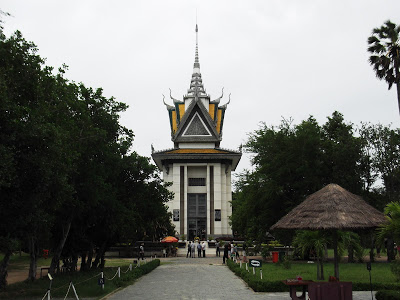
Like Tual Sleng above, this is a must see, because it is a horrific and important reminder of a dark side of humanity which we must remain vigilant against. The 17,000+ men, women, children and babies who had been sent from S-21 were executed at this former Chinese cemetery located about 10 miles outside of Phnom Penh, sometimes with blunt objects due to shortages of bullets. There is now a Buddhist Memorial Stupa packed full of more than 8,000 skulls that you can view through clear glass panels. These skulls came from the remains that were exhumed from nearby mass graves in 1980, and 49 of the adjacent communal graves still remain untouched.
5. Central Market (Psar Thmei)
Central Market
This Phnom Penh landmark is an art deco building completed in 1937. The huge dome in the middle is claimed by some to be one of the 10 largest domes in the world. There are four large wings that branch out from the middle, and each contains numerous stalls of goods of all kinds being sold to locals as well as tourists. It’s an excellent place for browsing as well as for taking some good photos of a traditional market in action.
6. Wat Phnom
Its name means ‘hill temple’ for a reason – it’s located on the only hill in town. Although the architecture isn’t as grand as its historical importance, it is still an interesting site to see. Legend has it that the first pagoda on the site was built in 1373 (the temple sanctuary has been rebuilt several times since then) to house four statues of Buddha which had been deposited by the waters of the Mekon and discovered by a wealthy widow named Madame Penh. Today many locals go there to pray for good luck, and many other locals go there to add to the somewhat chaotic atmosphere.
7. Massages and Spas
Yes, there are still unfortunately plenty of less-than-wholesome massage businesses in Phnom Penh, but there are also quite a few legitimate places to get a massage and some really nice spas as well, all for prices MUCH lower than what you would pay at home. One of the best value-oriented places, Seeing Hands Massage, employs blind masseurs which of course is great employment for a truly needy segment of Cambodian society.  On the upper end Bodia Spa gets many good reviews, but there are several others to choose from that are also well regarded.
8. Riverfront Bars and Restaurants
Phnom Penh riverfront
The riverfront itself is a nice place for a stroll, especially around sunset, and it can be quite a bit of fun indulging yourself a bit with the many bars and restaurants clustered around the area. And like the massages and spas mentioned above, you can get quite a bit for your money in both quantity and quality.
9. Shopping That Helps Cambodians
There are several shops located throughout the city that sell handicrafts and textiles to raise money for Cambodians in need. Many of the products are produced by cooperatives and are of high quality. These kinds of stores help ensure that the artisans and the disadvantaged get direct access to the profits, so please try to give them your business if you can. Cambodia Handicraft Association, Mekong Blue and NCDP Handicrafts are some of the many great stores to check out.
10. Bon Om Tuk (Water Festival)
Dragon boat
If you are lucky enough to be in Cambodia for this 3-day event that takes place every November you are in for a real treat. It’s a celebration of major naval battle victory that took place in 1177, and it likewise denotes the time of the year when the currents of the Tonle Sap River reverse direction due to the rainy season having ended the month before. As many as two million people from all over the country flock to the capital for the massive party, and the most colorful parts of the celebration are the dragon boat races in which over 350 boats participate every year.
All in all, if you find yourself bored in Phnom Penh you’ll have no one to blame but yourself.
Travel well!
******************************************
Source:About Keith Hajovsky,Since 1985 I have traveled throughout much of the United States and to over forty different countries within five continents for both business and pleasure. As my friends and family will tell you, I love to travel and I love to help others travel. If you are looking for someone to help you out with your travel plans or if you need a personal guide, please let me know!,http://travelsherpakeith.com/blog/

1.Wat Phnom (Wat Phnom Daun Penh) Wat Phnom,(Video clip of Phnom Penh) the namesake and symbol of the capital city of Phnom Penh, sets prominently atop an artificial 27 meter hill (or 'Phnom') in the northeastern section of the city. Legend has it that Daun Penh, a wealthy widow, retrieved a large koki tree trunk from the river. She had hoped to use it for a house, but inside a hollow of the trunk, she found four statues of the Buddha. She then ordered for a section of her property to be elevated for a small shrine to be erected to revere the statues. This became a sacred site and people started to settle around the hill; eventually, this became the city it now is. It is here that the city gets its name: ‘Phnom’ means hill in Khmer and ‘Penh’ is of course the name of the lady.
2.The Royal Palace of Cambodia is a complex of buildings, even though it is generally understood to be the royal abode of the King of Cambodia. The compound was the citadel of King Ponhea Yat (1393-1463) and rebuilt to its present state in 1886, when King Norodom (1834-1904) relocated the royal capital from Oudong to Phnom Penh. The buildings with beautiful towering spires are a great example of classic Khmer architecture found in Cambodia today.

Along with numerous other interesting buildings, within the 183,135 square meters (421m x 435m) compound is The Khemarin Palace, also known as Prasat Khemarin or the "Palace of the Khmer King." This is officially the residence of His Majesty, King Norodom Sihamoni

3.The Silver Pagoda, also known as the Preah Vihear Preah Keo Morokat (the Emerald Pagoda) to Cambodians, lies within the grounds of the Royal Palace, which is situated near the banks of the Mighty Mekong.

Originally a wooden structure, the palace was initially constructed in 1892 during the reign of King Norodom, but rebuilt to its present grandeur by King Norodom Sihanouk in 1962. The king spared no effort to make this a true embodiment of brilliant Khmer art. More than 5300 pcs of 1.125 kilo silver tiles are used to cover the floor of the Silver Pagoda, and the silver pieces collectively weigh over six tons.


4.The National Museum of Cambodia in Phnom Penh is the country’s leading historical and archaeological museum. It was officially inaugurated by King Sisowat in 1920.

5.Independence Monument (Vimean Ekareach) built in 1958 as a memorial to Cambodia's war dead and to celebrate independence from foreign rule, the monument stands majestically on the intersection of Norodom Boulevard and Sihanouk Boulevard in the centre of the city. It is designed by the influential Cambodian modern architect Vann Molyvann in the form of a lotus-shaped stupa in the same style seen at the great Khmer temple at Angkor Wat and other Khmer historical sites.

6.Phsar Thmey, also known as Central Market, is a unique colonial style building constructed in 1937. The location where the Central Market now sits was once a swamp area and occupied by a lake known as Beng Decho. Today, this beautiful market has become a prominent landmark in Phnom Penh. In the Khmer language, Phsar Thmey literally means ‘New Market’.


7.Phsar Toul Tum Poung (Russian Market),Toul Tum Poung market is often referred to as the Russian market because of its popularity among Russian expatriates during the 1980s. This market is popular to collectors of genuine antiques; also for those looking for good reproductions. 

8.Market,No shopping experience is complete without the thrills and satisfaction of shopping at night--especially one as a tourist in an exotic destination.

The night market in Phnom Penh, located in front of the Phsar Chas (Old Market) near the riverside, is perpetually crowded with tourists in search of a good bargain. At the moment, there are more than 150 stalls selling an array of items from clothing and ornaments to furniture and souvenirs. The entire setting of the Phnom Penh night market is made from natural material, and there are occasionally music performances and entertainment acts.


9.The riverfront offers some of the city’s most interesting sites including dozens of pubs, galleries, cafés, restaurants and shops that sit along one side of Sisowath Quay overlooking the Chaktomuk (the confluence of the Tonle Sap, Mekong and Bassac Rivers).

The park-like riverside is a great place to absorb local flavours and watch the locals unwind and enjoy a late afternoon stroll on the esplanade. Early risers may wish to check out the spectacular sunrise over the river in front of the Royal Palace.

10.The mighty Mekong River is indeed, in more ways than one, the lifeline that runs through the heart of southeast Asia. Rising from the Himalayan mountain of Tibet, it trickles and gradually winds its way through China, Myanmar, Thailand, Laos, Cambodia and Vietnam before spilling into the South China Sea. In its course, the mighty Mekong meets the Tonle Sap Lake which is the largest lake in South East Asia and effectively, the heartbeat of Cambodia. The annual pulsation of the flooding seasons has been a huge contribution to Cambodia’s existence for millenniums.

11.Toul Sleng Genocide Museum (S-21),Prior to 1975, Toul Sleng was a high school. When the Khmer Rouge came to power it was converted into the S-21 prison and interrogation facility. Inmates were systematically tortured to extract confessions, after which they were executed at the killing fields of Choeung Ek. S-21 processed over 17,000 people, less than a dozen of whom survived. The building now serves as a museum, a memorial and a testament to the madness of the Khmer Rouge regime.

12.Choeung Ek Memorial (The Killing Fields),Located about 17km south of Phnom Penh, Choeung Ek was once an orchard and a Chinese graveyard. It was used by the Khmer Rouge regime as an execution ground to put down thousands of people between 1975 and 1979. The site is now better known as the Killing Fields. Mass graves containing thousands of bodies were discovered at Choeung Ek after the fall of the Khmer Rouge regime. Many of the dead were former inmates in the Tuol Sleng prison.


13.Ounalom Monastery,The origin of the Ounalom Pagoda can be traced to as far back as the 15th Century. It was built in 1422 by King Ponyea Yat, the last king of the Khmer empire. It is one of the five original monasteries in Phnom Penh that King Ponhea Yat had built. Wat Ounalom is recognized as the ‘headquarters’ of Cambodian Buddhism. The patriarch, the chief abbot of Cambodia, resides here. The compound, forty four buildings in all, is about 250 metres north of the Royal Palace along Sisowath Quay at the river front. This monastery was home to over 500 monks and housed a huge library consisting of over 30,000 titles. During the regime of the Khmer Rouge, many of the buildings along with many religious statues and symbols were damaged, but most of which have since been restored. The buildings are used for a variety of purposes. There is the temple itself, schools, libraries, living quarters and the stupa that gives the temple its name; the stupa holds an Ounalum, a hair from the eyebrow of the Buddha.
14.Street 240's tree shaded avenue harbors a unique collection of quality boutiques and souvenir shops, offering Cambodian silks and silk fashions, Southeast Asian art, handicrafts, curios andfurniture. There are a few restaurants, bars, wine shops, bookstores, and travel agencies interspersed along the way. After visiting the Royal Palace, stroll around the corner to explore Street 240. Most of the shops are concentrated along the couple of blocks between Street 19 and Norodom Blvd. At the corner of Street 240 next to the Royal Palace, the Council of Ministers building sits distinctively, particularly photogenic in the late afternoon. Before heading up 240, consider taking a short detour through the park to Wat Botum to see the towering white 'Buddha Relic Stupa'. As you are walking up Street 240 from the Palace area note the well preserved colonial era villas on the south side of the street.

15.Boeung Keng Kang 1 (BKK1), bordered by Sihanouk, Norodom, Mao Tse Toung, and Monivong Boulevards, has been considered the city's 'foreigner quarter' since the 80s. The area is the base for many NGOs, embassies, expatriate residences and hotels catering to long-term visitors. The whole of Boeung Keng Kang 1 is dotted with visitor-oriented businesses hotels, restaurants, bars, silk shops, massage spas, travel agents and realtors, with the greatest concentration of businesses at the northern end in the Street 278/282 area, particularly between Streets 51 and 63. Street 278 is lined with restaurants, bars, shops and small hotels frequented by an interesting mix of NGO and IO workers as well as tourists and expatriates. The Street 278 area is well worth a visit and a stroll anytime of day, but especially for lunch or dinner, or even better, in the early evening when the bars are cafés are full and the street is at its liveliest.

16.Street 178 has long been known as 'Art Street' for the local sculpture shops and art galleries that line the road near the National Museum and Royal University of Fine Arts. Sculptors work on the street next to Wat Sarawan and the local galleries clustered near the Museum, most focusing on commercial and popular Cambodian art. But there are also a number of artists' galleries, handicraft and silk boutiques as well as a few restaurants and bars, especially close to the riverfront. The award winning Reyum Gallery is of particular note, which offers changing exhibitions of traditional and contemporary art by noted Cambodian artists. Toward the river end of 178 there are several restaurants and bars including the famous FCC. Phnom Penh Video clip


After being depressed for several years, Cambodia’s property market is now recovering slowly, fuelled by strong economic growth and the new foreign ownership law.

Despite the absence of official property price statistics, land prices in the country were estimated to have been rising recently. In Phnom Penh, Cambodia’s capital, land prices rose by an average of 15% during the first half of 2013 from the same period a year earlier, to US$2,350 per square meter (sq. m.), according to local real estate experts.

In the Boeung Keng Kang 1 (BKK1) area, land prices stood between US$3,500 and US$4,000 per square meter (sq. m.) in mid-2013, up from the pre-crisis levels of between US$3,000 and US$3,500 in 2008, according to Kuy Vat CEO of VTrust Group. The increase in land prices can be attributed to the increasing number of business and integrated services in the area.

In Takamau, the capital of Kandal Province, land values also increased by about 10% to 15% during the first half of 2013 from the same period last year, mainly due to the plan to build a new road, the Tumpun National Highway 2, according to some local property experts.

Sihanoukville, Cambodia'spremier island and beach resort, also saw modest increase in land prices, estimated at about 5%, during the first half of 2013 from a year ago, mainly fuelled by the construction of several hotels in the area.

Housing loans are up. During the first nine months of 2013, housing loans rose by about 11% y-o-y to US$103.6 million, according to Mrs. Phan, Executive Vice President of a local bank. Their average interest rate ranges between 9% and 11%, according to Canadia Bank.

There is also a noticeable increase in residential construction activity, including Casa Meridian 2, a 30-storey building, which began in late 2013 and expected to be completed in 2016. Prices for condominium units range from US$8,000 to US$60,000. There is also the ongoing Snake Island (Koh Puos) development project with villas, hotels and offices.

The ground-breaking of a 45-storey twin tower in Phnom Penh's Bassac Mon District, south of the Australian Embassy, is expected early this year.

The number of licensed real estate companies in Cambodia increased in 2013 to 59, up from 40 in the previous year, according to the Association of Evaluation and Real Estate Agents.  More foreign companies came in, reflecting property market growth and increased investor confidence.

New foreign ownership law boosts demand
Foreigners are now allowed to own apartments and condominium units, but not land, and therefore not the first floor of buildings, under the new foreign ownership law approved by King Norodom Sihamoni in May 2010.  Just after the passing of the law, tax revenues from property-related transactions soared 60% to KHR76.21 billion (US$19.5 million) in 2010, from KHR47.7 billion (US$12.2 million) in 2009.

In 2005, the Cambodian government amended its investment law to allow foreign ownership of buildings. However, the law not then implemented and the idea floundered, since the country was then experiencing one of the biggest property booms in Asia.

Land ownership is against the Constitution and is still out of the question. Land can however be held by foreigners on long (renewable) leases and through majority locally-owned companies incorporated in Cambodia. These structures are argued by lawyers in Cambodia to be safer than legal schemes in any other South East Asian country in which foreign land ownership is formally prohibited.

Analysis of Cambodia Residential Property Market » 


Cambodiabwell, Welcome !,Thank You For Visiting My Blog

Popular Posts

Contact me

Email:stryounkhngnum@gmail.com

My Opinion

My blog ,I Create for sharing about tourism site in Cambodia to all people around the world know about Cambodia Culture ,and especially ,is the part one of helping reduce poverty in the society.